table of contents
Sample preparation for bioluminescent toxicity testing determines which portion of a sample reaches the test organism and under what conditions. Collection, storage, dilution, filtration, and chemical adjustments therefore belong to the interpretation of the result.
For assays using Aliivibrio fischeri, preparation should follow the selected method and testing objective. A procedure developed for an aqueous sample cannot automatically be transferred to sediment, an extract, or a strongly colored industrial effluent.
The starting question is specific: what sample condition or fraction should the reported biological response represent?
For the method’s broader context, see Bioluminescent Toxicity Testing: Methods and Applications.
Define the sample fraction before preparation
A whole sample, a filtrate, an aqueous extract, and pore water represent different test materials.
ISO 11348-3 describes a freeze-dried luminescent bacteria method applicable to specified aqueous matrices, including wastewater, fresh water, extracts, leachates, sediment eluates, and pore water. The matrix named in the procedure matters when selecting preparation steps.
Before work begins, document:
- The original material received.
- The fraction intended for testing.
- The preparation procedure and method version.
- The biological endpoint required.
- Any comparison with other samples or treatment conditions.
For example, filtering a wastewater sample removes material from the tested fraction. The report should identify that fraction clearly so the result is not interpreted as representing the original whole sample without qualification.
Plan collection, transport, and storage together
Preparation starts before a sample reaches the instrument.
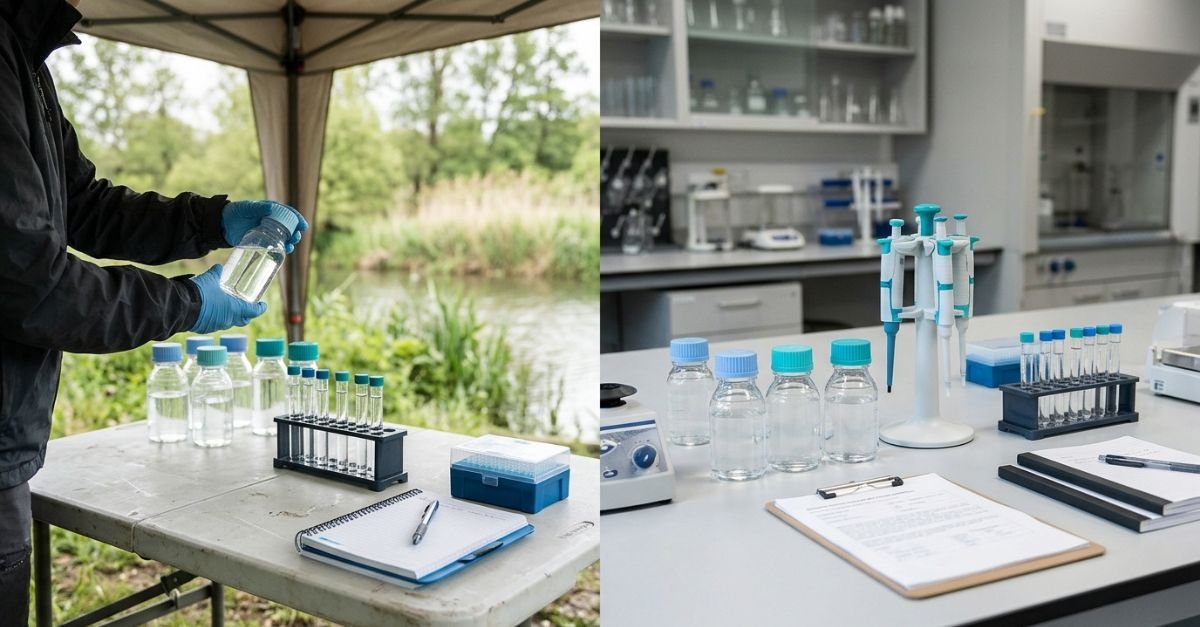
Confirm the method’s requirements for containers, sample volume, transport conditions, holding time, and preservation before collection. A separate aliquot may be necessary when the preservation required for a chemical analysis is unsuitable for the bioassay.
At receipt, record sample identification, collection and receipt times, container condition, temperature where required, and any reported preservation or handling.
Environment Canada’s sediment reference method provides detailed instructions for labeling, transport, storage, mixing, and characterization. These are requirements for that specific procedure, illustrating why a preparation plan must be tied to the matrix and method.
Use the applicable procedure to decide how the sample will be mixed or subsampled. Record departures from the planned handling conditions before evaluating the result.
Evaluate pH and salinity before making adjustments
pH adjustment depends on the objective
Measure and document pH as required by the procedure. Then determine whether adjustment is specified and how it affects the question being investigated.
A study examining interactions among pH, ions, and phenol found that sample and diluent composition influenced the bacterial response. Its findings support considering these conditions during interpretation.
An adjusted sample represents the conditions after that adjustment. When adjustment is required, retain the original measurement and record the reagent, amount added, and final condition.
Method requirements can differ substantially. Environment Canada’s cited solid-phase sediment procedure specifically prohibits sample pH adjustment. That instruction should not be generalized to every luminescent bacteria assay.
Salinity and diluent are part of the test system
Because A. fischeri is a marine bacterium, the assay medium requires defined osmotic conditions. Preparation must account for the original sample and the solutions introduced during testing.
Research by Correia Faria and Snook demonstrated that sodium chloride concentration and temperature affected luminescence and toxicity kinetics in their experimental system. The numerical conditions investigated were specific to that study.
Diluent selection also matters. Volpi Ghirardini and colleagues compared media used in a solid-phase toxicity test and found that results obtained with different diluents were not directly comparable under their study conditions.
Use the diluent specified by the method and document any substitution.
Address color and turbidity through the selected method
Colored or turbid samples require attention to the measurement approach.
Research published in the Journal of Environmental Monitoring examined a kinetic method designed to address color and turbidity interference. It showed that the optical approach and instrument design are relevant to testing these matrices.
ISO 21338 describes a kinetic direct-contact method for sediment suspensions, other solids, and problematic turbid or colored aqueous samples. This is a defined methodological approach whose applicability must be checked against the test system and procedure.
Select a supported approach before changing the sample solely to make it visually clear. Record any clarification, separation, or correction step and identify the resulting test fraction.
Prepare dilutions on a clearly defined concentration basis
The dilution plan should connect the original sample to the final exposure mixture.
Record each dilution and account for the volumes introduced by reagents and other solutions. The stated test concentration should follow the method’s reporting convention.
For concentration–response testing, establish the series before the run. Retain enough information to reconstruct how each exposure concentration was prepared.
This is particularly important when interpreting EC50 and percent inhibition. The sample concentration and the percentage biological response describe different quantities.
A useful preparation record separates:
- Original sample identification.
- Intermediate dilutions.
- Final test concentrations.
- Concentration units or sample fraction basis.
- Any permitted preparation changes.
Preparation decisions to document
| Preparation factor | What to establish | What to record |
|---|---|---|
| Sample fraction | Whole material, filtrate, extract, or pore water. | Material received and fraction tested. |
| Collection and storage | Conditions required by the method. | Relevant times, temperatures, and preservation. |
| pH | Whether adjustment is specified. | Original value, adjustment, and final value. |
| Salinity and diluent | Required assay medium and preparation. | Solutions used and amounts added. |
| Color and turbidity | Supported measurement or interference approach. | Treatment or correction applied. |
| Dilution | Final exposure concentration and reporting basis. | Dilution sequence and calculation records. |
These records help reviewers understand the relationship between the submitted material and the reported endpoint.
Coordinate sample and reagent preparation
Sample handling and bacterial reagent preparation are separate activities that must meet at the correct stage of the assay.
Plan their timing together. Confirm the instructions for reagent reconstitution, equilibration, temperature management, and use before starting the exposure sequence.
Keep reagent identity and lot records linked to the sample run. Use the method’s required controls and acceptance criteria to evaluate performance.
For BioLight Reagents, obtain the current product instructions and protocol documentation relevant to the intended workflow.
Review preparation before interpreting an unexpected result
When a response is unexpected, examine the preparation record alongside the measurement data.
Was the intended fraction tested? Were concentrations reconstructed correctly? Were adjustments documented? Did the required controls meet acceptance criteria?
Treat a change in preparation as a change requiring evaluation, especially when comparing results across dates, operators, or laboratories.
The preparation history should remain available with the final report. This gives the reviewer a basis for deciding whether results address the original testing question and whether comparisons are appropriate.
Discuss your sample requirements
Tell Aqua Science about your sample matrix, expected characteristics, testing objective, and required method. Contact the team to request the product and protocol documentation needed to evaluate your preparation workflow.
References
- ISO. ISO 11348-3:2007 — Method using freeze-dried bacteria.
- Environment Canada. Sediment toxicity using luminescent bacteria: procedure for testing sediment.
- Environmental Toxicology and Chemistry, 2010. Interactions between pH, potassium, calcium, bromide, and phenol and their effects on the bioluminescence of Vibrio fischeri.
- Correia Faria, E.; Snook, R. D., 2004. The effect of temperature and NaCl concentration on the kinetic method of toxicity determination using Vibrio fischeri.
- Volpi Ghirardini, A., et al., 2009. Microtox solid phase test: Effect of diluent used in toxicity test.
- Journal of Environmental Monitoring, 2004. Water toxicity monitoring using Vibrio fischeri: a method free of interferences from colour and turbidity.
- ISO. ISO 21338:2010 — Kinetic luminescent bacteria test.